






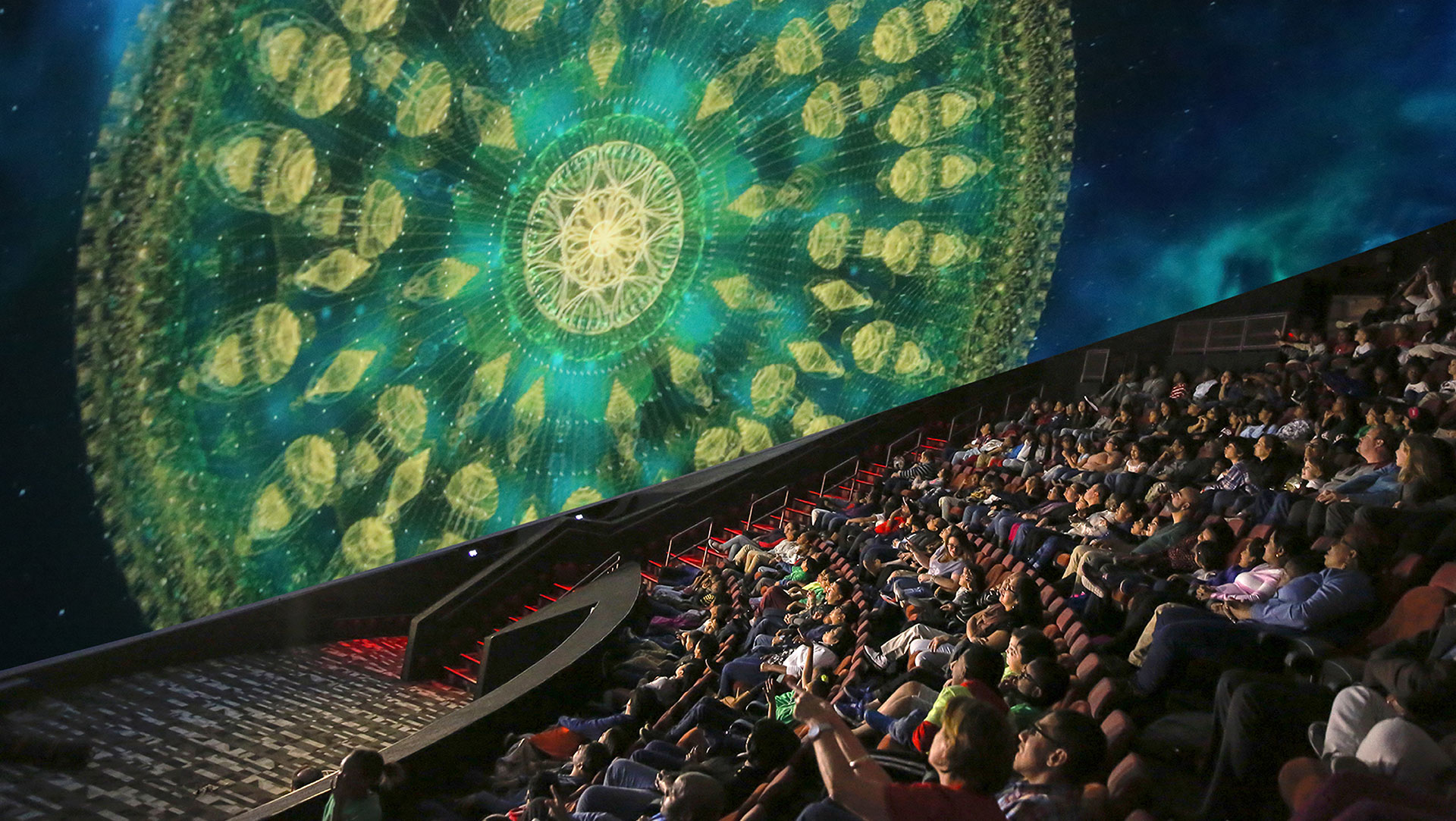

Spheres, 360° domes, and other wrap‑around immersive environments create an unusually powerful sense of presence, transporting audiences into story worlds both real and imagined. Like virtual reality (VR), these extended‑reality (XR) spaces surpass traditional cinema in their ability to evoke awe, wonder, empathy, and other transformative emotional states. And because they are shared, in‑person experiences—similar to concerts, ceremonies, sporting events and cinema—they can generate collective effervescence: a heightened sense of connection and emotional resonance among participants.
This combination of emotional potency and communal experience gives immersive environments extraordinary potential for social impact. Digital domes alone reach an estimated 100 million people annually, making them one of the most under‑recognized yet powerful platforms available to social impact entertainment (SIE) creators.
A Century of 360° Storytelling
Immersive dome projection traces its roots to the Zeiss Planetarium, first unveiled more than a century ago at the Deutsches Museum in Munich. The Zeiss Model I starball astonished early audiences by projecting a breathtakingly accurate celestial sphere onto a spherical screen.
From the beginning, planetariums served as immersive storytelling venues, guiding audiences on imagined journeys to the Moon, planets, and distant galaxies. Over the decades, new technologies expanded the medium with special‑effects projectors, all‑sky slide projectors and laser light shows. The introduction of Omnimax® (now IMAX® Dome) in 1973 brought 360° cinema into the giant‑screen ecosystem.
The late 1990s marked another leap forward with the arrival of fulldome video—multiple edge‑blended projectors driven by digital servers. Adoption spread rapidly, even outpacing early digital cinema. The 2004 “Dome Master” standard unified distribution, accelerating growth. Today, more than 2,000 digital dome theaters form a global network of immersive venues.
The XR Ecosystem Comes of Age
The rise of real‑time 3D graphics, CAVE environments, and VR headsets in the 1990s laid the foundation for today’s XR ecosystem. Tools such as 360° cameras, spherical editing software, advanced VFX pipelines, and high‑performance GPUs have dramatically expanded what creators can produce for domes—enabling rapid content development, real‑time navigation, and hybrid cinematic‑interactive experiences.
Many digital planetariums now offer joystick‑controlled exploration of scientifically accurate models of the universe. The Digital Universe atlas, curated by the American Museum of Natural History’s Hayden Planetarium, is a leading example. Interactive dome platforms such as Kinetarium even allow hundreds of audience members to participate simultaneously via their mobile devices, turning the dome into a massive shared game space.
The LED Dome Revolution
The arrival of LED dome screens represents a major technological breakthrough. With resolutions exceeding 8K, exceptional contrast, high brightness, and richly saturated color, LED domes surpass the visual quality of projection‑based cinema. Because projection domes suffer from scattered light and contrast loss, the shift to LED dramatically elevates image fidelity.
A growing number of manufacturers now offer LED dome systems, enabling upgrades to traditional planetariums and giant‑screen theaters while also powering new immersive arts, entertainment, and sports venues such as COSM and SPHERE.
The 360° Marketplace
The dome ecosystem spans three primary sectors:
- Giant screen / IMAX® Dome cinemas (100+ worldwide) Focused on nature and cultural documentaries, typically using gate‑share licensing.
- Digital (fulldome) planetariums (2,000+ worldwide) Primarily STEM‑focused, especially astronomy and space science, often using flat‑fee or perpetual licenses.
- Arts & entertainment domes (a rapidly growing category) Featuring visual music journeys, fine‑arts experiences, and live performances.
More than 500 fulldome titles are currently available, ranging from 20‑minute educational programs to 45‑minute giant‑screen documentaries and evening entertainment experiences. Distribution innovators such as WORLDS® have expanded access by four‑walling dome theaters and managing their own marketing and ticketing.
Unlike Hollywood, the fulldome community has long embraced a mission‑driven ethos—blending entertainment with education, inspiration, and social good. The field is now primed for a new generation of SIE storytellers.
The Future: Next‑Generation Immersion
New venues such as Madison Square Garden’s SPHERE and COSM are redefining what 360° experiences can be—combining live events, immersive sports multicasting, augmented feature films, and large‑scale fine‑arts presentations. SPHERE’s recent production of The Wizard of Oz demonstrates the narrative power of the medium at full scale.
Digital domes are evolving toward next‑generation 360° cinemas, group telepresence environments, and immersive performing‑arts stages. They are, in many ways, the most powerful out‑of‑home media delivery systems on the planet.
With such power comes responsibility. As immersive media expands, SIE filmmakers have a unique opportunity—and obligation—to shape this emerging landscape with intention, ethics, and impact.
Stay connected with the SIE Society for ongoing insights into immersive media, XR innovation, and the future of social impact storytelling.